


Syringes and needles are sterile instruments that are used to inject liquids into the body or remove secretions. A syringe is a glass or plastic cylinder with a plunger on one end and an aperture for a needle on the other. A hollow metal tube with a sharp tip serves as the needle.
What is the purpose?
When a little amount of fluid needs to be injected, a person can’t take the drug orally, or the drug would be destroyed by digestive secretions, a syringe and needle assembly is employed. A syringe and needle can be used to remove a variety of body fluids, the most frequent of which are tissue fluid from swollen joints and blood from veins.
Different types of needles
Medical needles and syringes purchased separately and then attached securely before use. You can always ask your doctor or a nurse for instructions on how to give the injection at home. Inquire about the needles you’ll need.
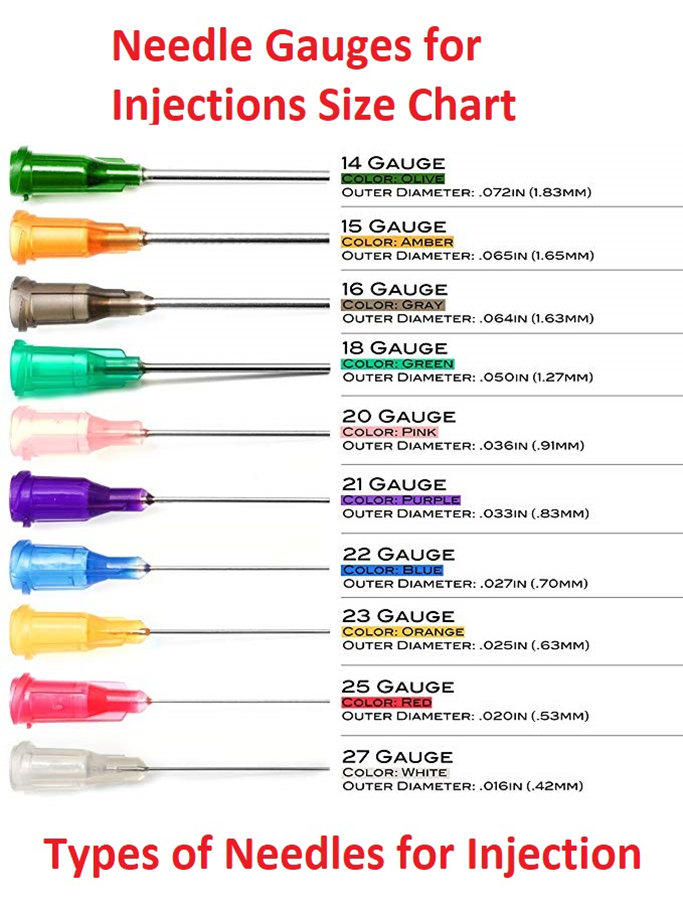
They range in size from a 27 gauge (0.42 mm) unit up to a 14 gauge unit (1.83 mm). They’re separated even further by color, with different colors indicating different whole sizes. A blue needle (0.70 mm), for example, is bigger and is used to smoothly suck from the pharmaceutical container.
Meanwhile, for inoculation, you should use a smaller needle with red and orange markings to reduce pain and bruising.
The visual assistance lets medical professionals see things more clearly, which saves time when inserting the needle to the syringe.
Different types of needle sizes
Apart from being familiar with the various types of needles, you need also be familiar with the various labels in order to better recognize them. On average, the label would say ’22 G 1/2,’ with 22 G denoting the needle’s gauge and 1/2 denoting the length of half an inch.
Keep in mind that the greater the gauge number, the thinner the needle.
Different types of needle gauge
For an adult, a 21 to 23 gauge needle 1 to 1.5 inches long is recommended for IM (intramuscular) injections. A 1 inch length, 25 to 27 gauge needle is used while knitting a child. 1.5 to 2 inch needles may be required for obese patients.
Adults and toddlers alike should use a 25 to 27 gauge 3/8 to 5/8 inch long needle for SQ (subcutaneous) injections. Some newer diabetic drugs, like as Byetta, call for ultra-fine needles of 30 or 31 gauge 1/3 inch.
Different needle lengths
The length of the needle varies depending on the patient’s age and where the medicine needs to be administered. A tiny needle, rather than a large one, should suffice for children. Also keep in mind that some drugs only absorb superficially, or beneath the epidermis. In some circumstances, the drug is injected deep into the muscle. As a result, the needle length will vary.
Subcutaneous injections
Subcutaneous injections are also available, which are administered directly into the fatty tissue beneath the skin. The needle should be small and short, with a gauge of 25 to 30, and measure around one-half to five-eighths of an inch in length in this situation.
Intramuscular injections
These injections are given by doctors into the muscle. This calls for a needle that is thicker and longer, with a gauge of 20 to 22 G. These needles are roughly an inch or an inch-and-a-half long.
The patient’s body fat density is also important since you must account for how far the needle must travel beyond the skin to reach the muscle.
If you need to inject yourself on a regular basis for medical reasons, it’s critical that you understand the many types of needles and Medical s犀利士
yringes, as well as the various lengths.
Make an appointment with your doctor to learn how to inject yourself or someone else at home properly. After each usage, remember to dispose of the syringe and needle in a safe and secure manner.
Different types of syringe Sizes
Syringes are labeled according to the volume of liquid they can hold and are separated into three sizes: small, medium, and large.
Syringe capacity measurement
The liquid volume is measured in millilitres (ml). The volume of solids is measured in cubic centimetres (cc) (1 cc = 1 ml). When injecting your medication at home, make sure you get a syringe that can hold the exact quantity of medicine that your doctor ordered. If your doctor has prescribed only 3 cc in one dose, for example, you may need to choose a little syringe that can correctly store the medicine. It will also be easier for you to correctly fill the syringe with the correct syringe. Similarly, if your prescription calls for 10 cc in a shot, you’ll want to use a big syringe with a capacity of up to 15 cc so you don’t have to shoot yourself twice to acquire the complete dose.